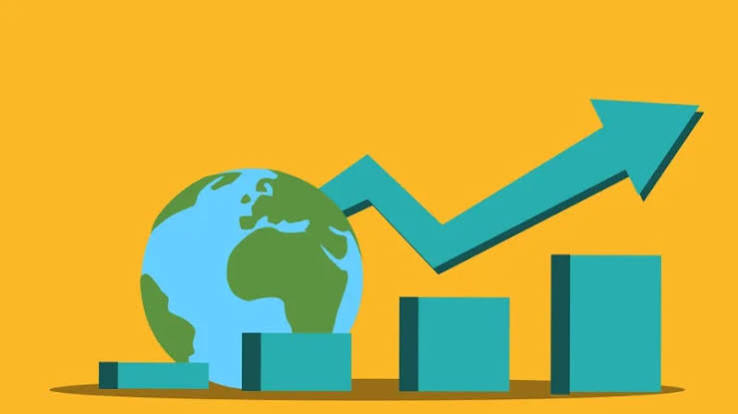
A bright yellow background, a globe showing Europe and Africa, four rising teal bars and a bold arrow zigzagging upward. The illustration is cheerful and simple, and it raises a question every news reader meets sooner or later: when we say the world economy is growing, what exactly is growing?
What the image shows
The flat-style graphic places a blue-and-green globe at the left, with its Africa and Europe side facing us. Beside it, four bars climb in height from small to large, and above them a teal arrow dips once before shooting upward past the final bar. Nothing is labeled, so it carries no data. It is a symbol of growth rather than a record of it.
The small dip in the arrow is worth noticing. Real economies rarely rise in a straight line.
How growth is measured
When economists and news outlets talk about growth, they usually mean the change in gross domestic product, or GDP, which is the total value of goods and services a country produces in a given period. Global growth combines the figures for many countries, typically weighted by the size of each economy.
A few points help in reading these numbers:
- Nominal vs. real: Real growth adjusts for inflation, so it shows whether people are actually producing and buying more, not just paying higher prices.
- Total vs. per person: A country can grow overall yet see little change in income per person if its population is growing quickly.
- Averages hide differences: A healthy world average can coexist with some regions growing fast and others stagnating.
What drives growth
Most explanations come back to a handful of drivers:
- More workers or better-skilled workers, through education and training
- More capital, such as machines, buildings, roads and networks
- Higher productivity, from new technology and better ways of organizing work
- Trade, which lets countries specialize and reach larger markets
- Stable institutions, including reliable legal systems and sound public finances
In recent years, digital technology and artificial intelligence have been added to the list of hoped-for boosts, though economists differ on how quickly they will show up in the statistics.
The dip in the arrow
The zigzag in the illustration reflects how growth actually behaves. Shocks such as financial crises, pandemics, wars, energy price spikes and natural disasters can interrupt expansion. Policy choices on interest rates, taxes and spending can speed up or slow down recovery. Periods of slowdown are a normal part of the economic cycle, even if they are painful for those affected.
Growth is not the whole story
Many analysts argue that growth should be judged alongside other measures:
- Distribution: Who benefits, and whether the gains reach poorer households.
- Jobs and wages: Whether growth creates decent, secure work.
- Environment: Whether it depends on pollution or on depleting natural resources, a concern the globe in the image quietly invites.
- Wellbeing: Health, education, safety and quality of life, which GDP does not capture directly.
Governments and international organizations increasingly publish broader indicators alongside GDP for this reason.
Why it matters at home
Global growth feeds into daily life through fuel and food prices, export orders, job openings, interest rates and the value of money sent home by workers abroad. For an export-oriented economy like Bangladesh, demand from major trading partners matters a great deal, which is why news on growth in Europe, North America and Asia gets close attention from factories and policymakers alike.
How to read growth headlines
- Check whether the figure is a forecast or an actual result, since forecasts are revised often.
- Look at the time period: quarterly, annual or projected over several years.
- Ask which countries and sectors are driving the number.
- Compare official sources, such as national statistics offices, central banks and international institutions.
- Be wary of any single figure presented without context.
The takeaway
The rising bars and arrow in the picture tell an appealing story, and growth really can lift incomes and open opportunities. But a good reader looks beyond the arrow to ask what is growing, who gains and what it costs. That habit makes economic news much easier to understand.
Copyright & Disclaimer
© 2026 Frontara News. All rights reserved. This article is original content written for frontaranews.com. No part may be reproduced, copied or redistributed without prior written permission, except for brief quotations with proper credit and a link back to the original article.