Flags, Forecasts and Fraud: Why the IMF-World Bank Meetings in Bangkok Matter to Everyone
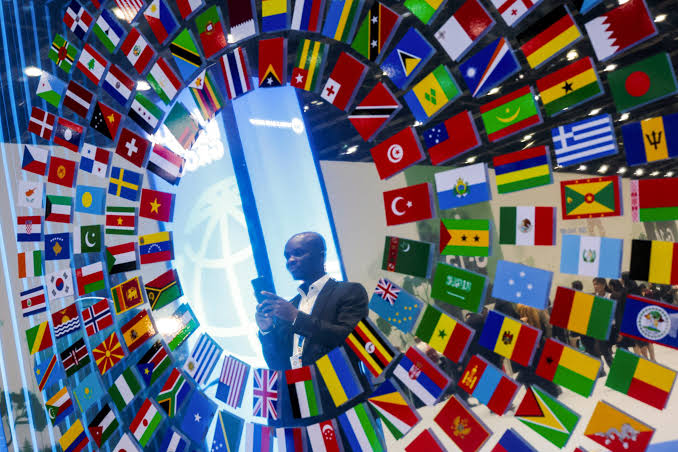
A man in a dark suit checks his phone in front of a huge circular wall of national flags. The setting looks like the display at a major international gathering, and this week one is under way in Bangkok.
What the image shows
The photograph shows a curved installation made of dozens of national flags arranged in a ring, with a pale globe emblem glowing at its center. In front of it, a man in a dark jacket and white shirt, wearing what looks like a conference lanyard, stands with his phone in hand. The flags reflect in a glossy surface around him, giving the scene a layered, almost kaleidoscopic look.
I can’t confirm from the picture alone which event it was taken at, so please check the photo’s caption and source before captioning it. The setting does resemble the displays used at large international economic meetings, which makes this a fitting moment for the article.
A global gathering, right now
The 2026 Annual Meetings of the IMF and the World Bank Group are being held in Bangkok from October 12 to 18. Organizers describe more than 1,000 official sessions and roughly 15,000 participants, including finance ministers and central bank governors from the institutions’ member countries. Such meetings bring together central bankers, ministers, private sector leaders, civil society, media and academics to discuss the most pressing issues facing the global economy. The plenary session was set for October 16. thailand 2026 +3
The meetings do not always take place in Washington. They are usually held for two consecutive years at the institutions’ headquarters and every third year in a member country. Thailand is among only three nations to have hosted them twice, having first done so in 1991. amwalalghadthailandnow
What came out of the week so far
The headline moment was the IMF’s World Economic Outlook, released on Tuesday. It projects global growth at 3.1 percent in 2026 and 3.4 percent in 2027, with global average inflation at 4.7 percent in 2026, easing to 4.1 percent in 2027. One report on the outlook said the global economy has stayed resilient, but sustaining that resilience is becoming increasingly costly. unbdhakatribune
For individual countries, the outlook has been less comfortable. For Bangladesh, the IMF now forecasts growth slowing to 3.2 percent in fiscal 2026-27. Bangladesh’s finance minister used the Bangkok meetings to ask development partners, including the IMF and the World Bank, for assistance. unbdhakatribune
A blueprint against digital fraud
A notable item on the host’s agenda is online scams. The Bank of Thailand plans to unveil a “Bangkok Blueprint,” developed with the IMF and the World Bank, to combat digital financial fraud and strengthen trust in the digital economy. Other themes include artificial intelligence, green finance and economic resilience. thailandnownationthailand
That focus reflects a real concern. As payments, banking and shopping move online, fraud, phishing and impersonation scams have become a growing problem in many countries, including Bangladesh.
Why these meetings matter beyond the conference hall
It would be easy to dismiss such events as talk among officials. But decisions and signals from these meetings can reach ordinary life in several ways:
- Forecasts shape policy. Governments and companies use IMF and World Bank projections when planning budgets, investment and borrowing.
- Financing decisions. The institutions provide loans, grants and policy advice, especially to countries facing balance-of-payments or development challenges.
- Market confidence. Warnings about debt, inflation or slow growth can influence investors and credit ratings.
- Global standards. Frameworks on issues such as fraud, climate finance and digital payments can influence national rules.
What critics say
The institutions also attract criticism. Some argue that loan conditions can be too strict for poorer countries, that voting power favors wealthier members, and that forecasts are revised so often they should be treated with caution. Supporters counter that the IMF and World Bank provide a forum and financial backstop that no single country could replace. Readers are best served by treating their numbers as informed estimates and not as certainties.
What to watch next
As the meetings close on October 18, key things to follow include any announcements on financing for developing countries, how the Bangkok Blueprint is received and implemented, further commentary on inflation and interest rates, and how countries such as Bangladesh respond to downgraded forecasts.
The takeaway
The ring of flags in the photograph makes a simple point: the world’s economies are interdependent, and their leaders still meet in person to compare notes, share warnings and try to coordinate. Whether the week produces concrete help or mostly statements, it offers a useful window into how the global economy is being read by those who monitor it.
Copyright & Disclaimer
© 2026 Frontara News. All rights reserved. This article is original content written for frontaranews.com. No part may be reproduced, copied or redistributed without prior written permission, except for brief quotations with proper credit and a link back to the original article.