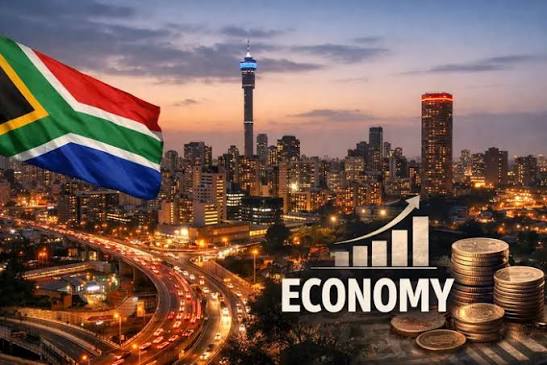
A waving South African flag, a glowing city skyline at dusk, a rising bar chart and stacks of coins, all under the word “ECONOMY.” The picture sums up a country of great strengths and stubborn problems.
What the image shows
The illustration places the national flag in the upper left, above a busy city lit up at twilight. A tall, lit tower and several office blocks rise above crowded highways, and the skyline resembles Johannesburg, the country’s commercial center. In the lower right, bold white text reads “ECONOMY” beneath an upward arrow over four bars, with coins stacked beside it.
Where the numbers stand
South Africa is among Africa’s largest and most industrialized economies, but recent forecasts show modest growth. S&P Global Ratings cut its 2026 GDP growth forecast to 1.3 percent from 1.5 percent, while the World Bank lowered its own to 1.0 percent from 1.4 percent, pointing to weaker global demand, higher energy costs and uncertainty. The economy grew 0.5 percent in the first quarter of 2026, a sixth straight quarter of expansion. businessreportiol
That steady run is a positive sign, but the pace is slow for a country with big development needs. S&P expects medium-term growth to improve only gradually, reaching 1.8 percent by 2028 and 2029. iol
The jobs crisis
Unemployment is the defining challenge. One analysis of first-quarter 2026 data put the official rate at 32.7 percent, with youth unemployment among 15 to 24-year-olds at 60.9 percent. That source is a statistics aggregator, so check the latest Statistics South Africa release before quoting exact figures. Earlier Treasury analysis described the problem as structural: the labour force is growing faster than job creation, and faster, more inclusive growth that supports labour-intensive sectors is seen as the key to reducing unemployment. statisticsoftheworldsanews
Inflation and interest rates
South Africa has made progress on prices. The Reserve Bank adopted a new 3 percent inflation target, replacing the old 3 to 6 percent band, and inflation in 2025 was close to that at 3.2 percent. The picture has become less comfortable this year. S&P raised its average inflation forecast to 4.3 percent from 3.5 percent and expects the repo rate, now at 7 percent, to end 2026 at 7.25 percent. Higher energy prices are a key driver, and the central bank faces a difficult balance between supporting growth and keeping inflation in check. allianz-tradeiol
Energy: a turnaround story
One of the better stories is electricity. Years of rolling blackouts, known locally as load shedding, were estimated to have cost the economy a large share of output. According to one 2026 analysis, the state utility Eskom has effectively ended load shedding, with more than 300 consecutive days without power cuts as of early 2026. Reliable power is a precondition for factories, mines and households alike, and investment in renewable energy is adding to the recovery. statisticsoftheworld
Minerals, trade and the wider region
South Africa remains a major exporter of minerals. The rand rallied in 2025 on the back of gold and other precious metals, among the country’s main sources of hard currency, and the country’s supply chains are deeply connected with the rest of Africa. The same analysis noted that the Africa-wide trade agreement could enlarge South Africa’s regional role, and that better infrastructure could raise export capacity and profitability. allianz-tradeallianz-trade
What holds the economy back
Analysts commonly cite a mix of long-running constraints:
- Infrastructure: Rail, ports and roads need investment and better management.
- Productivity: South Africa’s total factor productivity has stalled since the early 2000s, with weaker human capital productivity. allianz-trade
- Inequality: High unemployment falls hardest on young people and on historically disadvantaged communities.
- Global exposure: Weak demand abroad, trade tensions and fuel price swings feed directly into growth and prices.
- Climate risk: The country is considered particularly exposed to weather patterns that have historically brought drought and reduced crop output. iol
What to watch next
Developments worth following include the next quarterly GDP and jobs data from Statistics South Africa, Reserve Bank interest rate decisions, progress on rail and port reform, the pace of renewable energy investment, and the government’s budget and debt path. For readers in Bangladesh and other emerging economies, South Africa’s experience, including the costs of power shortages and the difficulty of creating jobs, offers useful comparisons.
The takeaway
The image pairs a glowing skyline with a rising chart, and both are fair parts of the story. South Africa has real strengths in minerals, finance, industry and regional trade, along with encouraging signs such as improved electricity supply. But with growth around one percent and joblessness near a third of the labour force, the gap between potential and reality remains wide.
Copyright & Disclaimer
© 2026 Frontara News. All rights reserved. This article is original content written for frontaranews.com. No part may be reproduced, copied or redistributed without prior written permission, except for brief quotations with proper credit and a link back to the original article.