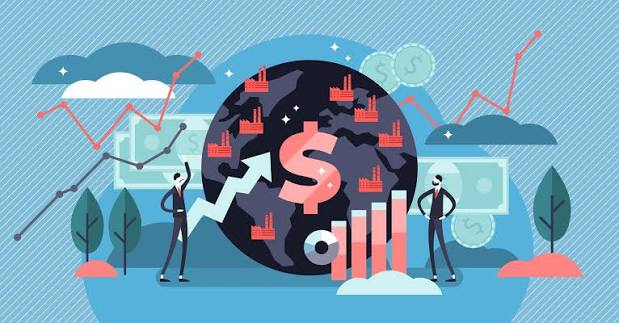
A flat-style illustration shows a dark globe stamped with a large dollar sign, dotted with red factories, while two men in suits stand beside rising charts. It is simple artwork, but it sums up the forces that drive the world economy.
What the image shows
At the center is a globe covered in small red factory icons, with a big dollar symbol across its face. A white zigzag arrow climbs beside it, a red-and-pink bar chart rises on the right, and line graphs trace ups and downs in the sky. Banknotes and coins sit behind the globe, clouds drift overhead, and a few trees stand at the edges. On either side, a businessman looks on: one gazes up at the arrow, the other stands with hands on hips beside the bars.
The message is clear: the world’s money, production and growth are tied together.
How the global economy fits together
No country’s economy is fully separate. Production, trade and finance link them in several ways:
- Trade: Goods and services cross borders daily, from raw materials and components to finished products.
- Industry and supply chains: A single product may be designed in one country, assembled in another and sold in a third.
- Finance: Investment, loans and currency flows move capital to where it is expected to earn the most.
- The dollar’s role: The U.S. dollar is widely used for trade invoicing, reserves and borrowing, so shifts in U.S. interest rates and the dollar’s value can ripple through other economies.
What the rising arrow really depends on
Economic growth does not happen automatically. Analysts generally point to a few ingredients:
- Productivity: Producing more with the same resources, through better skills, technology and organization.
- Investment: Spending on factories, infrastructure, education and research.
- Stable institutions: Predictable laws, secure property rights and trusted public services.
- Open markets: Access to customers and suppliers beyond national borders.
- Confidence: Households and firms willing to spend and invest rather than hold back.
The factories and the price of progress
The red factories scattered across the globe are a fair symbol of how manufacturing has driven development for countries from Europe to East Asia, and increasingly South Asia. Industry creates jobs, raises incomes and builds export earnings. Bangladesh’s garment sector is a well-known example of how manufacturing can lift incomes and bring many workers, including large numbers of women, into formal employment.
The trees at the edges of the picture hint at the cost, however. Industrial growth has historically brought pollution, resource depletion and higher greenhouse gas emissions. Governments and companies now face pressure to grow while cutting environmental harm, through cleaner energy, efficiency and recycling.
Risks to watch
The economic picture is rarely a straight line upward, as the zigzag graphs in the image suggest. Common risks include:
- Inflation and interest rates: Rising prices and higher borrowing costs can slow spending and investment.
- Debt: High public or private debt can limit governments’ room to respond to shocks.
- Trade tensions: Tariffs, sanctions and export controls can disrupt supply chains and raise costs.
- Currency swings: A stronger dollar can make imports and debt repayments more expensive for countries that borrow in dollars.
- Shocks: Wars, pandemics, extreme weather and energy price spikes can quickly change the outlook.
- Inequality: Growth does not always reach everyone equally, within countries or between them.
What it means for ordinary people
Global trends can feel distant, yet they shape daily life: the price of fuel and food, the interest rate on a loan, the availability of jobs and the value of remittances sent home. For households, practical habits help: keeping an emergency cushion, avoiding unnecessary high-interest debt, and diversifying income where possible.
What to watch next
Key questions in the coming months include how central banks balance inflation against growth, how supply chains are being reorganized, how fast clean energy investment expands, and whether emerging economies can attract steady, affordable financing.
The takeaway
The illustration is bright and optimistic, with arrows pointing up and figures looking on calmly. The real economy is messier, moving in cycles with winners and losers. Still, the central idea holds: production, trade and money form one connected system, and understanding it is a good first step toward making sense of the news.
Copyright & Disclaimer
© 2026 Frontara News. All rights reserved. This article is original content written for frontaranews.com. No part may be reproduced, copied or redistributed without prior written permission, except for brief quotations with proper credit and a link back to the original article.