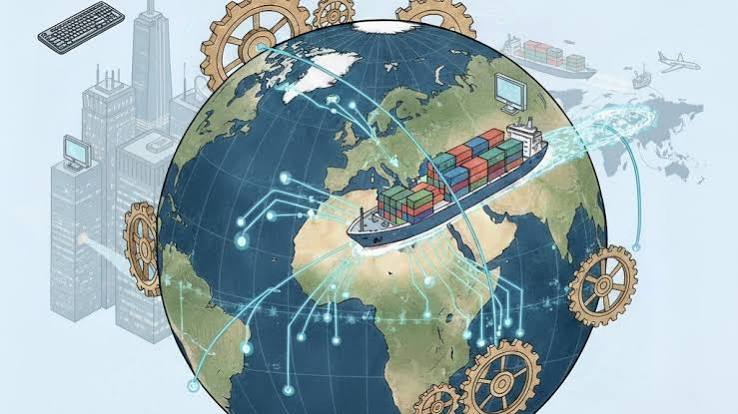
A container ship sails across a globe wrapped in glowing network lines, with giant gears at its edges, skyscrapers on one side and a keyboard and monitors floating nearby. The illustration shows what is easy to forget: nearly everything we buy arrives through a vast, interlocking machine.
What the image shows
At the center is a globe centered on Africa and Europe, with a large cargo ship stacked high with colorful containers sailing across it. Thin lines with glowing nodes spread from the ship over the continents, like a digital network. Brass-colored gears turn around the globe’s rim, a faded city skyline stands at the left with a keyboard and computer screens above it, and in the upper right a second cargo ship and an aircraft appear in the haze.
The picture combines three ideas: physical transport, digital coordination and the mechanical interdependence of it all.
Where most of our goods really travel
Although air freight carries high-value and urgent items, the great bulk of international trade by volume moves by sea. Standardized steel containers can be loaded onto ships, trains and trucks without unpacking the contents, which transformed the cost and speed of moving goods. A pair of shoes, a phone component or a bag of coffee may cross several oceans and borders before it reaches a shelf or doorstep.
The digital layer
The network lines in the image point to something less visible than the ship: data. Modern logistics depends on software that tracks cargo, books space, files customs paperwork, predicts delays and plans routes. Sensors, satellite positioning and increasingly artificial intelligence help companies see where goods are and adjust when plans change. When systems fail or are attacked, shipments can pile up as quickly as when a port is blocked.
Chokepoints and fragility
The globe-spanning machine is efficient, but it has weak points. A few narrow passages and major ports handle a large share of world trade, so disruption in any of them can ripple outward:
- Canals and straits: A blockage, conflict or drought-related restriction can force ships onto longer routes, adding time and fuel costs.
- Ports and labor: Congestion, strikes or equipment shortages can delay cargo for weeks.
- Weather and climate: Storms, floods and extreme heat can interrupt shipping, rail and road links.
- Geopolitics: Sanctions, tariffs and security threats can reroute trade or raise insurance costs.
- Cyber risks: Attacks on shipping lines, ports or logistics software can halt operations.
The pandemic years and several later disruptions made many businesses and consumers aware of how a delay far away can mean empty shelves and higher prices at home.
The shift toward resilience
In response, many companies and governments are rethinking supply chains. Common strategies include:
- Diversifying suppliers so that no single country or factory is a single point of failure
- Holding larger inventories of critical items, accepting higher storage costs for more security
- Moving production closer to home or to friendlier partners, sometimes called nearshoring or friend-shoring
- Investing in digital visibility to spot problems earlier
- Building port and rail capacity to ease bottlenecks
Each approach has trade-offs. Resilience often costs more than pure efficiency, and some of those costs are passed on to consumers.
The environmental dimension
Shipping carries a large share of the world’s trade but also produces significant greenhouse gas emissions and local air and water pollution. The industry is under pressure to cut its footprint through cleaner fuels, more efficient ships, slower steaming and better route planning. International bodies have set emissions goals, though how quickly the fleet can change is a continuing debate.
Why it matters for Bangladesh
For an export-driven economy like Bangladesh, whose garments travel to markets in Europe, North America and beyond, shipping costs, port efficiency and delivery times directly affect competitiveness. At the same time, the country imports fuel, machinery, raw materials and food, so disruptions elsewhere can raise domestic prices. Investment in ports, customs systems and inland transport links is a recurring policy priority.
What to watch next
Developments worth following include freight rates and shipping route changes, new trade agreements and tariffs, progress on cleaner shipping fuels, automation at ports, and how companies reorganize their sourcing in response to risk.
The takeaway
The gears in the illustration are a fair metaphor. Global trade works because many parts turn together: ships, ports, factories, software, regulations and people. When they mesh, goods flow cheaply and quickly. When one jams, the effects are felt far beyond the point of failure. Understanding that machine helps explain a lot of today’s economic news.
Copyright & Disclaimer
© 2026 Frontara News. All rights reserved. This article is original content written for frontaranews.com. No part may be reproduced, copied or redistributed without prior written permission, except for brief quotations with proper credit and a link back to the original article.