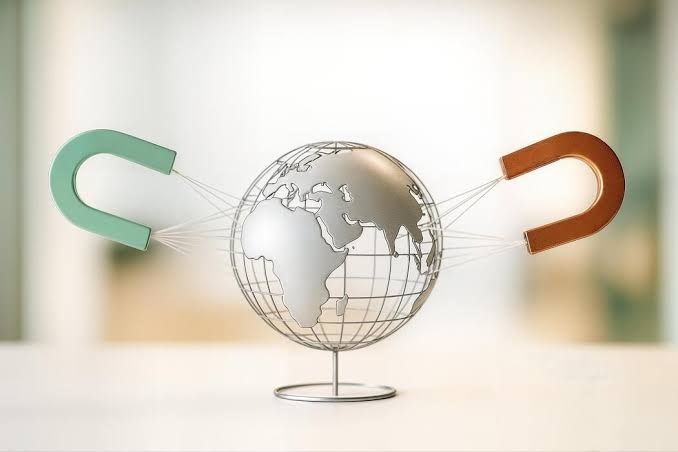
A globe held between two opposing magnets captures the central tension of modern geopolitics: nations being drawn toward competing poles.
The image is simple but striking. A silver wireframe globe, with Africa, Europe and Asia clearly visible, sits at the center. On the left, a teal magnet reaches toward it. On the right, a copper-colored one does the same. Thin threads stretch from each magnet to the globe, and the world hangs in the balance between them.
It is a fitting picture of how many analysts describe international affairs today.
A world with two poles of attraction
For much of recent history, global politics was described as a contest between blocs, whether military alliances, trading systems or competing economic models. Today the pull comes from several directions at once: major powers courting partners, investors chasing growth, and governments choosing which standards, technologies and supply chains to rely on.
Many countries, particularly in Africa, Asia and Latin America, now find themselves courted by several powers at the same time. Some try to hold a middle path, trading with everyone and committing fully to no one. Others lean toward one side to secure investment, security guarantees or access to technology.
The pull of trade and technology
Magnets work through invisible force, and so does much of modern influence. Trade agreements, infrastructure loans, digital platforms, currency arrangements and the rules governing artificial intelligence all draw countries into one orbit or another. Once a country builds its ports, networks and payment systems around one set of standards, switching later becomes costly.
That is why decisions about telecoms equipment, data rules or energy supply, which may look technical, often carry strategic weight.
The risk of a stretched world
The image also hints at a danger. A globe pulled hard in two directions can be strained. When economies are pressed to choose sides, the costs include fragmented supply chains, higher prices, duplicated technology systems and fewer shared rules. Smaller countries often have the least room to maneuver and the most to lose from a rupture.
At the same time, the threads in the picture are thin. Influence is rarely absolute, and countries can and do rebalance their relationships when interests change.
What readers should watch
The questions worth following in the coming months include:
- Which countries are deepening or hedging their partnerships
- How trade and technology rules are being written, and by whom
- Whether international institutions can still help bridge divides
- How ordinary people feel the effects, through prices, jobs and access to goods and services
The takeaway
The globe in the picture stays upright because the forces on either side are roughly in balance. Whether the real world finds a similar equilibrium, or tilts toward one pole, is among the defining questions of this decade.
Copyright & Disclaimer
© 2026 Frontara News. All rights reserved. This article is original content written for frontaranews.com. No part may be reproduced, copied or redistributed without prior written permission, except for brief quotations with proper credit and a link back to the original article.