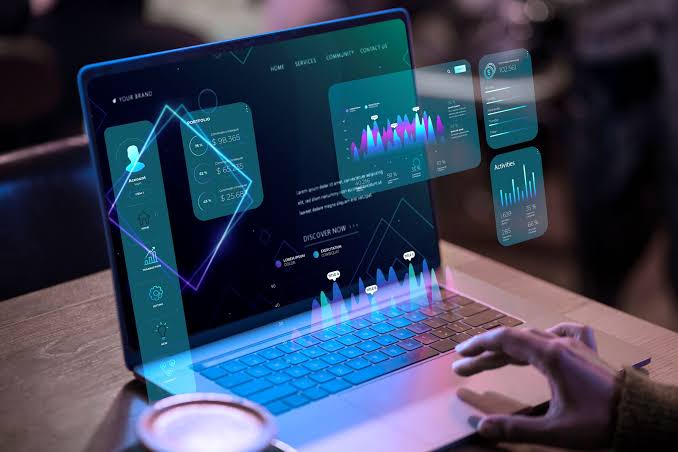
A laptop glows on a café table, its screen filled with portfolio figures, charts and activity panels that seem to float above the keyboard. A hand rests on the trackpad and a cup of coffee sits nearby. It is an everyday scene, and it shows how deeply finance has moved onto our screens.
What the image shows
The picture is a stylized, futuristic take on a familiar moment. The laptop displays a dark interface with a profile icon, portfolio cards showing dollar-style balances and percentages, a navigation bar with “Home,” “Services,” “Community” and “Contact Us,” and a prompt reading “Discover Now.” Translucent panels with purple and blue bar charts and a small “Activities” widget hover beyond the screen, as if the data were stepping out into the room. The blurred café background suggests someone managing money on the go.
The balances and labels are placeholder content, so they should not be read as real figures.
Money in the app era
A generation ago, checking an account meant visiting a branch or waiting for a paper statement. Today, millions of people:
- Check balances and transactions in real time on their phones or laptops.
- Send and receive payments instantly, often with a few taps or a QR code.
- Invest in funds or shares through online platforms with low minimum amounts.
- Budget and track spending with apps that sort expenses into categories.
- Apply for loans or insurance online, sometimes with decisions in minutes.
This shift is often grouped under the term fintech, short for financial technology.
Why it has spread so quickly
Several forces are behind the growth:
- Smartphones and cheap data: More people can reach financial services without a nearby bank branch.
- Mobile wallets: In many countries, including Bangladesh, mobile financial services have given people without traditional bank accounts a way to save, send and receive money.
- Convenience: Services are available around the clock, and onboarding is often faster than at a branch.
- Competition: New entrants have pushed established banks to improve their apps and lower some fees.
Benefits worth noting
Digital finance can widen access, especially for people far from cities or those who were previously excluded from formal banking. It can cut transaction costs for small businesses, make remittances faster and give users clearer information about their own spending. For freelancers and online sellers, it makes receiving payments from customers far away much easier.
The risks behind the glow
A convenient interface can also hide real dangers:
- Fraud and phishing: Scammers send fake messages, links and calls pretending to be banks or payment services.
- Account takeovers: Weak or reused passwords make it easier for criminals to get in.
- Impulse decisions: Easy access and flashy charts can encourage hasty trading or borrowing.
- Hidden costs: Fees, interest rates and risks are not always obvious on a clean screen.
- Data privacy: Financial apps hold sensitive personal information that must be protected and handled responsibly.
- Unregulated products: Some online schemes promise very high returns with little explanation, which is a common warning sign of a scam.
Staying safe: practical steps
- Use strong, unique passwords and turn on two-factor authentication.
- Never share one-time passwords, PINs or card details, and remember that legitimate banks do not ask for them.
- Avoid public Wi-Fi for financial transactions, or use a trusted secure connection.
- Check the web address and app source before logging in or downloading.
- Be skeptical of offers of guaranteed or unusually high returns.
- Review statements regularly and report suspicious activity quickly.
- Keep devices and apps updated.
The role of regulators
Governments and central banks are working to keep pace with these services, setting rules on licensing, consumer protection, anti-money-laundering controls, data security and digital payments. Rules differ from country to country, so users should check that a platform is authorized in their jurisdiction before trusting it with money.
What to watch next
Trends to follow include the expansion of instant payment systems, the use of artificial intelligence in credit decisions and fraud detection, the debate over digital currencies, and efforts to bring more people into formal finance. For Bangladesh, the growth of mobile banking, online commerce and freelancing makes secure, affordable digital finance especially significant.
The takeaway
The laptop in the picture shows how easy it has become to see and move money from almost anywhere. That convenience is real and valuable, but it works best alongside caution, financial literacy and trusted, regulated providers. The interface may be sleek, but the decisions behind it still belong to the person at the keyboard.
Copyright & Disclaimer
© 2026 Frontara News. All rights reserved. This article is original content written for frontaranews.com. No part may be reproduced, copied or redistributed without prior written permission, except for brief quotations with proper credit and a link back to the original article.