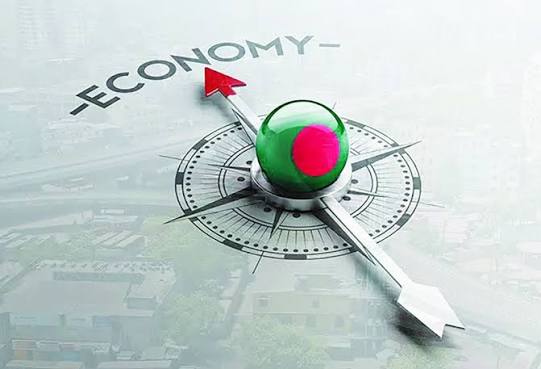
A compass needle swings toward the word “ECONOMY,” with a globe in the colors of the Bangladesh flag at its center. This week’s forecasts from international lenders suggest the country is looking hard for direction.
What the image shows
The picture is a stylized compass lying over a hazy aerial view of a dense city. A red-tipped needle points to the word “ECONOMY” at the top, while a glossy green sphere with a red disc, the national flag, sits at the compass’s center. It is a clear metaphor for a country choosing its economic course.
The latest forecasts
The compass fits the moment. At the IMF-World Bank Annual Meetings in Bangkok, the IMF projected that Bangladesh’s GDP growth could dip to 3.2 percent in fiscal year 2026-27. It also expects average inflation to climb to 10.9 percent in that year, after an estimated 3.6 percent growth and 8.7 percent inflation in FY26. unbprothomalo
The IMF is not alone. The World Bank has cut its FY27 growth forecast to 3.4 percent, citing a severe drought in investment and persistent high inflation that erodes purchasing power. The ADB had earlier projected 4 percent. The IMF’s number is the lowest among the three major lenders. bdnews24dhakatribune
The gap with official targets
The forecasts sit well below the government’s own ambitions. The BNP-led government has targeted 6.5 percent growth for FY27, which is 3.1 percentage points above the World Bank’s latest projection. Figures for last year also differ by source: the Bangladesh Bureau of Statistics published provisional FY26 growth of 4.14 percent, while the lenders’ estimates are lower. Readers should treat such differences as a reason to check which source and which definition a headline is using. bdnews24bdnews24
Why growth is slowing
According to the reporting, several pressures are converging:
- Weak investment: Government investment has fallen to a historic low amid acute fiscal constraints and implementation challenges. asianews
- Energy shortages: The World Bank points to gas and electricity shortages disrupting industrial production, along with weak private investment and employment. prothomalo
- Banking stress: Rising non-performing loans and capital shortfalls in the banking sector are also cited as challenges. unb
- Global spillovers: The World Bank earlier pointed to spillovers from conflicts involving the United States, Israel and Iran. bdnews24
- A long slide: Growth was 7.1 percent in FY22 before slowing in the years since, and the World Bank warned of a fourth consecutive year of slowing growth. asianews
Prices still pinch households
Inflation is the pressure most families feel directly. The Bangladesh Bureau of Statistics put overall inflation at 8.34 percent in September. Earlier data from the Planning Ministry showed price inflation outpacing wage growth, which widens the gap for workers. When wages lag prices, real purchasing power falls, even if paychecks rise on paper. prothomalounb
Bright spots
The picture is not entirely gloomy. The ADB says strong remittance flows and a stable services sector are supporting the economy despite difficult conditions. Remittances from workers abroad remain a vital lifeline for households and for foreign exchange. Earlier in the fiscal year, gross foreign exchange reserves had strengthened to USD 33.19 billion in December 2025. Readers should check the latest central bank figures, since reserves move month to month. bdnews24unb
Risks ahead
New tariffs or trade restrictions, slower growth in major export markets, tighter access to foreign financing and climate-related risks could also weigh on the economy. For an export-driven country whose garment industry depends on buyers in Europe and North America, shifts in global demand and trade rules matter a great deal. bdnews24
How the region compares
The wider South Asian picture shows sharp differences. The IMF projects India to lead the region at 7 percent growth with 4.4 percent inflation, with Bhutan at 6.9 percent and the Maldives at 3.8 percent. The contrast highlights that Bangladesh’s slowdown reflects domestic and structural challenges as well as global conditions. asianews
What economists say needs attention
Analysts quoted in recent coverage and official outlooks tend to return to a handful of priorities:
- Restoring investor confidence through policy stability and reforms
- Fixing energy supply, since factories cannot grow without reliable gas and electricity
- Strengthening banks by addressing bad loans and capital gaps
- Controlling inflation while protecting the poorest households
- Improving targeted social protection, the theme of the World Bank’s latest Bangladesh update
- Diversifying exports and moving toward higher value-added activity
What households and businesses can do
- Keep a modest emergency cushion and avoid unnecessary high-interest debt.
- Compare prices and plan larger purchases carefully while inflation remains high.
- Businesses can review energy use, diversify customers and watch cash flow closely.
- Beware of investment schemes promising guaranteed returns, which tend to multiply in uncertain times.
The takeaway
The compass in the picture points at “economy,” but the needle has not settled. Forecasts show a country with real strengths, from resilient remittances to a large workforce, facing a difficult stretch of slower growth and high prices. The coming months will test how quickly policymakers can restore investment, fix energy bottlenecks and steady the banking system.
Copyright & Disclaimer
© 2026 Frontara News. All rights reserved. This article is original content written for frontaranews.com. No part may be reproduced, copied or redistributed without prior written permission, except for brief quotations with proper credit and a link back to the original article.