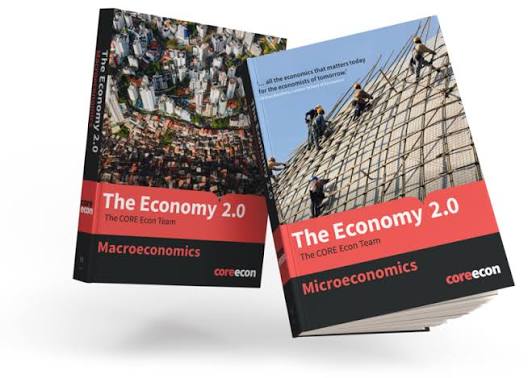
Two books float side by side: one on Macroeconomics, with an aerial photograph of a dense city, and one on Microeconomics, showing workers climbing bamboo scaffolding. Both carry the title The Economy 2.0 and the name of the CORE Econ Team. The covers are a small window into a big debate about how economics should be taught.
What the image shows
The picture is a product-style mockup of two paperback volumes. The Macroeconomics volume shows a city seen from above, where tightly packed buildings spread across the frame, and the Microeconomics volume shows construction workers on scaffolding against a blue sky. Both have a red band across the cover with the title, the authors and the publisher’s logo.
What the books are
The Economy 2.0 is the second edition of CORE Econ’s original textbook, a complete rewrite that brings together the latest research with feedback from instructors. It comes in two volumes, Microeconomics and Macroeconomics, so that instructors teaching only one subject can use just one. WikipediaWikipedia
The most unusual part is the price. The Economy 2.0 is available free online and is also published as a print book by Hackett Publishing Company. CORE describes it as an open-access textbook for any first course in economics, whether principles, micro or macro. Wikipediacore-econ
Who is behind it
CORE Econ is a non-profit educational project. Its team includes leading economists such as Samuel Bowles of the Santa Fe Institute and Wendy Carlin, director of the CORE project and a professor at University College London. The project was conceived in late 2012, and its textbook is taught as an introductory course at almost 600 universities. newsouthbooksWikipedia
What makes it different
The publisher’s description points to several features that set it apart from the traditional introductory text:
- Real-world problems first. It asks students to address forms of inequality and social problems, and it motivates its models and concepts with evidence and real-world applications. abbeys
- Modern tools. It aims to build mastery of the conceptual and quantitative tools of contemporary economics. readings
- Wide-ranging topics. According to CORE’s own contents page, the macroeconomics volume covers unemployment, inflation, debt, money and the financial sector, macroeconomic policy in the global economy, and how disequilibrium in the economy or environment can lead to rapid and possibly catastrophic changes in prices or climate. core-econ
- Teaching support. The free resources for instructors include a test bank with over 1,000 auto-gradable questions, articles from the Financial Times and The Economist mapped to the course, and editable lecture slides. readings
- Many languages. As of 2024, the earlier edition was available in English, Italian, French, Spanish, Finnish, German and, in part, Portuguese. Wikipedia
Why textbooks matter
For many students, the first economics course shapes how they read the news for the rest of their lives. The questions it raises, such as why prices change, why some people earn more than others, whether markets work fairly, and what governments should do when things go wrong, are the same ones that appear in headlines about inflation, jobs, trade and climate.
Cost also matters. Standard university textbooks can be expensive, and for students in lower-income countries, a high price can be a real barrier. Free, open-access material lowers it. Even the print edition of the Microeconomics volume has been listed by retailers at prices above $140 Australian, which shows why a free digital version makes a difference.
The wider debate
The project is part of a longer conversation about economics education. Critics of traditional courses have argued that they lean heavily on abstract models and give too little attention to institutions, inequality, power, history or the environment. Supporters of the conventional approach reply that clear core models are an essential foundation and that new approaches must still teach rigorous methods. CORE sits in the first camp but stresses quantitative tools, and readers can judge the balance for themselves.
What it means for readers in Bangladesh
For students and self-learners in Bangladesh and across South Asia, an open-access textbook offers a free way to study modern economics, from the basics of supply and demand to inflation, unemployment and financial systems. Teachers can adapt the lecture slides and exercises, and learners can pair the material with local data from Bangladesh Bank, the Bangladesh Bureau of Statistics and news coverage. Understanding the concepts makes economic news, such as this month’s forecasts about growth and inflation, much easier to follow.
How to get started
- Visit CORE Econ’s website to read the digital edition free of charge.
- Begin with the Microeconomics volume if you are new to the subject, or Macroeconomics if you want to understand national economic issues first.
- Work through the exercises, since economics is best learned by doing.
- Compare each unit with a current news story to see the ideas in action.
The takeaway
The two books in the picture show how much has changed in how economics is taught: a free textbook, written by an international team, built around current problems and available to anyone with an internet connection. Whether or not it replaces the older approach, it widens access to the subject, which may be its most important contribution.
Copyright & Disclaimer
© 2026 Frontara News. All rights reserved. This article is original content written for frontaranews.com. No part may be reproduced, copied or redistributed without prior written permission, except for brief quotations with proper credit and a link back to the original article.