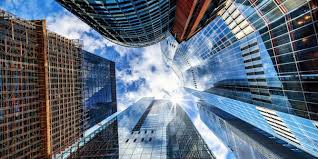
Shot from street level, tall glass skyscrapers lean in toward a bright patch of sky with white clouds, and the sun flares between their edges. The upward view is a classic image of ambition, and it arrives at an interesting moment for the world’s office buildings.
What the image shows
The photograph looks straight up between several high-rise buildings with mirrored and gridded facades. The glass reflects the blue sky and clouds, so the towers seem to blend into one another, while a warm sunburst gleams between them. There are no people or signs in the frame, so it works as a general picture of the modern business district.
Why towers like these matter
Office towers are more than architecture. They house banks, law firms, technology companies, government agencies and thousands of daily jobs. They also anchor surrounding businesses, from cafés and shops to transport services, so the health of an office district tends to shape the health of the city around it.
The office after the pandemic
The pandemic changed how and where people work, and office markets have been adjusting ever since. The latest research suggests a gradual recovery with an uneven pattern.
- Leasing is rebounding. JLL reported that global office leasing rose 5 percent in 2025, surpassing 2019 volumes. crexi
- U.S. vacancy is stabilizing. CoStar said U.S. office vacancy fell to 14 percent in the first quarter of 2026, 20 basis points below its mid-2025 record peak. It expects the rate to hold steady through 2026 and ease gradually toward 13 percent by 2030. CBRE measures the market differently and forecasts year-end 2026 vacancy at 18 percent. The gap between the two figures is a reminder that different firms use different definitions. PRESS RELEASE +2
- Companies are rethinking space. In CBRE’s 2026 survey, two-thirds of respondents said they plan to maintain or expand their office space over the next three years, and 64 percent of tech firms plan to grow their footprint. cbre
A tale of two markets
The recovery is not even. CBRE notes that the gap between prime and non-prime vacancy is now the widest on record. Newer, well-located buildings with strong amenities and sustainability features are attracting tenants, while older, less competitive buildings struggle. That shapes decisions about conversions, renovations and, in some cases, demolition. cbre
Why it matters beyond real estate
Office trends ripple through the wider economy:
- City finances: Property taxes from commercial buildings fund public services in many cities.
- Local business: Foot traffic from office workers supports restaurants, retail and transport.
- Banks and investors: Commercial property is a major asset class, and stress in the sector can affect lenders and pension funds.
- Jobs: Construction, facilities management, security and cleaning all depend on occupied buildings.
Skylines in South Asia
For fast-growing cities such as Dhaka, the picture is different from that of mature Western markets. Rapid urbanization, a young workforce and expanding services and technology sectors create demand for modern commercial space. But land costs, traffic congestion, power supply, building safety and planning rules shape what gets built and how well it serves the people inside. Those questions are especially pressing for cities where infrastructure has not kept pace with growth.
Challenges for tall buildings
- Energy and emissions: Large glass buildings can use significant energy for cooling and lighting, so efficiency and green certification are growing priorities.
- Safety and standards: Fire safety, structural quality and enforcement of building codes are crucial, particularly in dense cities.
- Flexibility: Hybrid working means many firms want adaptable spaces rather than fixed layouts.
- Affordability: High rents can push out smaller businesses and fuel debates about who the city is built for.
What to watch next
Trends worth following include office occupancy and leasing data, interest rates and their effect on property values, the spread of green and flexible building design, conversions of older offices into homes or mixed-use space, and how artificial intelligence changes the number and type of office jobs.
The takeaway
The upward view in the image is a good metaphor for the sector: confident from below, but more complicated up close. Office buildings are not disappearing, but they are being re-sorted by quality, location and flexibility. How cities adapt will decide whether their skylines stay lively or turn into half-empty monuments.
Copyright & Disclaimer
© 2026 Frontara News. All rights reserved. This article is original content written for frontaranews.com. No part may be reproduced, copied or redistributed without prior written permission, except for brief quotations with proper credit and a link back to the original article.