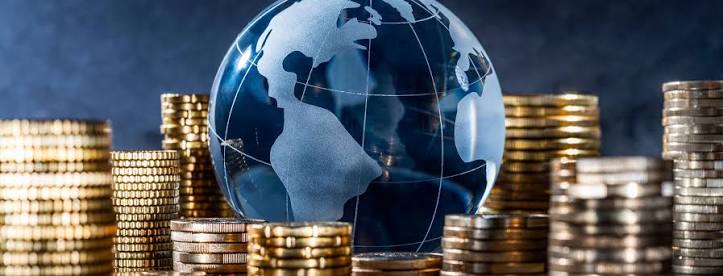
A glass globe rests among stacks of gold and silver-colored coins against a dark blue backdrop. The image is a classic symbol of global finance: the world, and the money that moves through it.
What the image shows
At the center is a transparent globe with the Americas facing the viewer, etched with fine latitude and longitude lines. Around it rise columns of coins of different heights, golden on the left and silver on the right, with a few lower stacks in the foreground. The lighting is dramatic, and the dark background makes the metal glow. Nothing in the picture is labeled, so it is a metaphor rather than data.
Money is global, but not equally shared
Wealth is spread unevenly across the planet. A small number of economies hold a large portion of global output and financial assets, while many others are still building the savings, infrastructure and institutions that support growth. Within countries, too, the gap between the richest and poorest households can be wide.
The uneven stacks in the image are an apt reminder: the world’s money is not a single pile but many different ones, with different owners and uses.
How money moves across borders
Capital flows around the world in several ways:
- Trade payments: Exporters and importers settle bills in major currencies, with the U.S. dollar and the euro the most widely used.
- Foreign investment: Companies build factories and buy businesses abroad, while investors purchase shares and bonds in other countries.
- Remittances: Workers abroad send money home, a vital source of income for families and a significant part of the economy in countries such as Bangladesh.
- Lending and aid: Governments and institutions lend to or fund other countries for development, emergencies and infrastructure.
- Currency trading: Banks, funds and companies exchange currencies constantly, shifting exchange rates minute by minute.
What moves exchange rates
A currency’s value against others reflects a mix of influences:
- Interest rates: Higher rates can attract investors seeking better returns, pushing a currency up.
- Inflation: Faster-rising prices can erode a currency’s purchasing power.
- Trade balance: Countries that import far more than they export can face pressure on their currencies.
- Confidence and stability: Political uncertainty or doubts about public finances can prompt investors to pull money out.
- Reserves: Central banks hold foreign currency and gold to defend their money and calm markets.
Gold itself, which the coins in the picture evoke, has long served as a store of value in uncertain times, although its price also swings with interest rates, the dollar and investor mood.
The weight of debt
Money in the global system is also borrowed money. Governments, companies and households all take on debt to invest or spend. Borrowing can fund roads, schools and businesses that raise future income. But when debt grows faster than the ability to repay it, or when interest rates rise, repayment can strain budgets and force painful choices.
For developing economies that borrow in foreign currencies, a stronger dollar or higher global interest rates can make debt service much more expensive, a pressure that international institutions have been watching closely.
What it means for ordinary people
Global finance can feel remote, but it reaches daily life through:
- Prices: Exchange rates affect the cost of imported fuel, food, medicine and electronics.
- Interest rates: Mortgage, loan and credit card costs follow wider trends.
- Jobs: Investment and trade shape where businesses hire or cut back.
- Savings: The value of money kept in a bank or invested depends on inflation and returns.
- Remittances: Exchange rates determine how much recipients get when money arrives from abroad.
Practical habits for households
- Build an emergency fund that covers several months of expenses, where possible.
- Be careful with high-interest and foreign-currency borrowing.
- Spread savings and investments rather than relying on one asset.
- Compare fees and exchange rates when sending money internationally.
- Avoid offers promising guaranteed high returns, which are a common sign of fraud.
What to watch next
Key questions include how central banks balance inflation and growth, how debt burdens evolve in developing economies, whether the dollar’s dominant role shifts, how digital payments and central bank digital currencies develop, and how much gold and other assets investors seek as a safe haven.
The takeaway
The glass globe sits among coins, reminding us that the world economy ultimately rests on trust: trust in currencies, contracts and institutions. When that trust is strong, money flows to where it can be useful. When it weakens, the effects can spread quickly across borders. Knowing a little about how the system works makes the headlines easier to read and personal financial choices easier to make.
Copyright & Disclaimer
© 2026 Frontara News. All rights reserved. This article is original content written for frontaranews.com. No part may be reproduced, copied or redistributed without prior written permission, except for brief quotations with proper credit and a link back to the original article.