
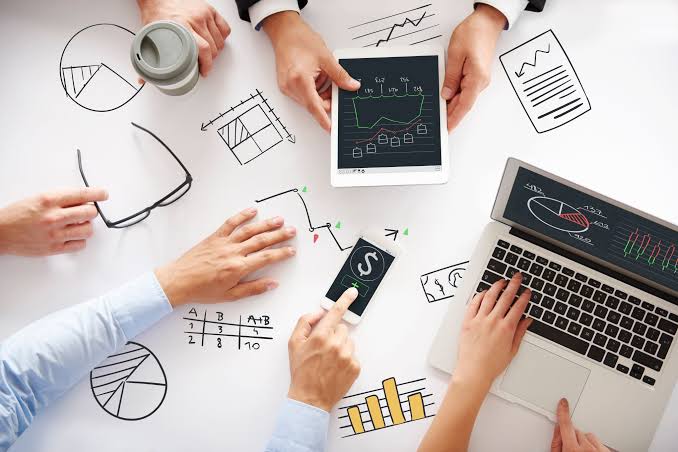
From above, a white desk is covered with hand-drawn pie charts, a small table of numbers, a tablet showing a line graph, a phone with a dollar-sign app and a laptop displaying a pie chart and candlestick chart. Hands from several people reach in, and a coffee cup and a pair of glasses sit nearby. It is a snapshot of how modern money decisions get made: together, and with a lot of data.
What the image shows
The photograph is taken straight down onto a desk. Four sets of hands are at work: one holds the edge of a tablet displaying a green and red line chart, another taps a smartphone screen marked with a dollar symbol, a third types on a laptop showing a pie chart and a stock-style candlestick chart, and a fourth rests beside a small table of letters and numbers. White-background sketches of bar charts, pie charts and a document surround them. The scene suggests brainstorming, analysis and planning all at once.
Why teams analyze money together
Whether it is a start-up working out its budget, a family planning savings or an investment club comparing stocks, the process looks similar:
- Gather information: revenue, costs, prices, interest rates and past performance
- Visualize it: charts make patterns and outliers easier to see than rows of numbers
- Discuss assumptions: what must be true for the plan to work?
- Test scenarios: what happens if sales fall, costs rise or interest rates move?
- Decide and review: make a choice, write it down and check results later
Different views around the table are an advantage. A person who spots a risk early can save the group a costly mistake.
The markets behind the charts
The candlestick and line charts in the image are tools for reading financial markets, where prices change constantly in response to news, earnings, interest rates and investor mood. Recent weeks show how many forces can move at once. LPL Research reported that U.S. stocks rose in the first full trading week of October, notching fresh record highs, while investors debated narrow market leadership, rising Treasury yields, easing odds of an October rate hike, and the risk of fresh Middle East disruptions. Other market commentary noted that oil prices were holding above $100 a barrel, with markets reacting to U.S. statements about the conflict with Iran. Market conditions change quickly, so readers should check the latest data before drawing conclusions. lplinvestrade
Reading charts wisely
Charts are powerful but can mislead. A few habits help:
- Check the scale. A truncated vertical axis can make a small change look huge.
- Look at the time frame. A one-week rise may be just noise in a longer decline, and vice versa.
- Remember that past performance is not a promise about future results.
- Ask where the data came from and whether it is complete.
- Beware of patterns that look convincing. People are good at seeing trends in random movements.
Basic ideas behind sensible investing
For readers new to investing, a few widely taught principles are worth knowing. They are general ideas, not recommendations.
- Risk and return are linked. Higher potential returns usually come with a higher chance of loss.
- Diversification spreads money across different assets, sectors or countries so that one failure does less damage.
- Time horizon matters. Money needed soon is usually treated differently from money set aside for decades.
- Costs add up. Fees and taxes quietly reduce returns over time.
- Emergency savings come first, so that a sudden expense does not force the sale of investments at a bad moment.
- Avoid borrowing to speculate, since losses can exceed what you put in.
Warning signs of scams
The dollar-sign app on the phone is a reminder that money moves quickly on a screen, and so do scams. Common red flags include:
- Promises of guaranteed or unusually high returns
- Pressure to act immediately
- Requests for payment through unusual channels or for secret codes
- Unlicensed platforms or advisers with no verifiable registration
- “Insider tips” and social media hype about a sure win
Checking that a platform is authorized by the relevant financial regulator is a sensible first step in any country.
What it means for Bangladesh
In Bangladesh, mobile banking, online trading platforms and remittance flows have made financial tools more accessible, and a growing young workforce is interested in saving and investing. That also raises the importance of financial literacy: understanding inflation, interest rates and the difference between saving, investing and gambling. High local inflation, which the IMF expects to remain elevated, makes it all the more important for households to think about how their money keeps its value.
Habits worth building
- Track income and spending for a few months to see where money goes.
- Build an emergency fund before taking investment risks.
- Learn the basics from trustworthy sources such as regulators, central banks and reputable educational sites.
- Write down why you make each investment, and review it regularly.
- Talk to a licensed professional for personal advice.
The takeaway
The desk in the photograph is messy in a productive way: sketches, devices and ideas all in play. Good financial decisions rarely come from a single chart or a hot tip. They come from curiosity, careful questions and a willingness to discuss risks openly, ideally before money is on the line.
Copyright & Disclaimer
© 2026 Frontara News. All rights reserved. This article is original content written for frontaranews.com. No part may be reproduced, copied or redistributed without prior written permission, except for brief quotations with proper credit and a link back to the original article.